
Ardmore, PA Bat Removal Services
Seitz Wildlife Services is a fully licensed, family-owned and operated company providing bat removal and wildlife control throughout Ardmore, Lower Merion Township, and the surrounding Main Line. We handle the full range of bat situations property owners run into — bats in an attic, bats in a chimney, bats roosting behind shutters and trim, and bats flying through living space. Our services also include bat guano and dropping removal, attic clean-outs, insulation replacement, bat house installation, and bat proofing, also known as bat exclusion.
Ardmore has two things that make it consistently productive ground for bats: old buildings and old trees. Lower Merion holds one of the densest and most mature street tree canopies in the Philadelphia suburbs, and that canopy — along with the Mill Creek and Indian Creek corridors running through the township — supports a large nightly insect population. Bats forage over that ground after dusk and then need a dry, dark, undisturbed place to spend the day. In a community where a great deal of the housing stock predates 1930, those places are easy to find. If you’re dealing with a bat intrusion in Ardmore, contact Seitz Wildlife Services for a free phone consultation.
How Bats Get Into Ardmore Homes
Ardmore’s housing falls into a few distinct categories, and bats exploit each one differently. Knowing which kind of home you own tells you a lot about where to look first.
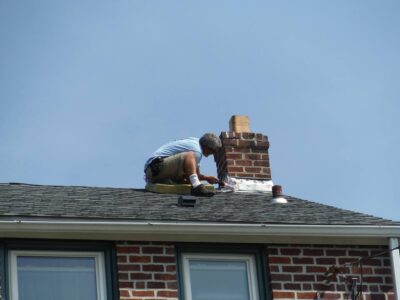
Stone Main Line homes with slate roofs. The large stone and stucco-over-stone houses built across Lower Merion between the 1890s and the 1920s are, from a bat’s perspective, close to ideal. They have complicated rooflines with multiple gables and dormers, deep eaves, generous attic volume that holds a stable temperature, and slate roofing where individual tiles lift or slip over time. The copper and lead flashing at chimneys and roof valleys on these homes is often original, and a century of freeze and thaw opens gaps at exactly the seams a bat needs. A gap the width of your finger is enough.
Twins and attached homes near Lancaster Avenue. A large share of Ardmore’s housing between the train line and Suburban Square is stone twins and attached rows from the 1910s through the 1930s. These carry a specific complication: the roofline and often the attic space is shared with the house next door. A colony that entered through your neighbor’s gable end can be roosting directly above your ceiling, and an exclusion performed on only one half of a twin frequently just moves the problem sideways. When we inspect an Ardmore twin, we look at both halves of the structure and talk through what needs to happen on the shared roofline — even when only one homeowner has called.
Mid-century and later infill. The newer homes scattered through Ardmore and neighboring Haverford and Wynnewood fail in different places: ridge vent ends that were never properly sealed, gable louvers with degraded screening, soffit and fascia gaps where the roof meets a bumped-out addition, and construction seams around dormers and skylights.
Signs of a Bat Infestation in Ardmore, PA
Bats are quiet and mostly nocturnal, so a colony can occupy an attic for a full season before anyone notices. The most common signs Ardmore homeowners report:
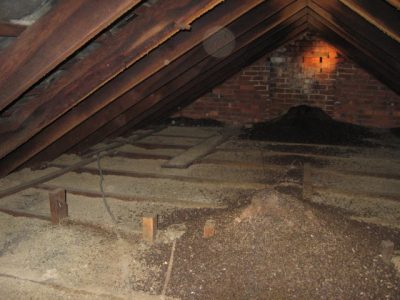
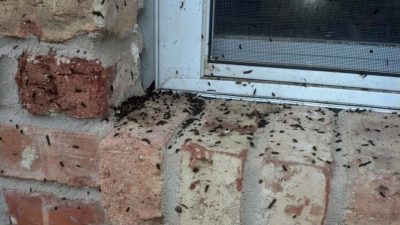
- Droppings, called guano. Small, dark, crumbly pellets that collect in piles below entry points — along a foundation, on a windowsill, on porch furniture, on the driveway beneath a gable. Guano in an attic accumulates directly under the roost.
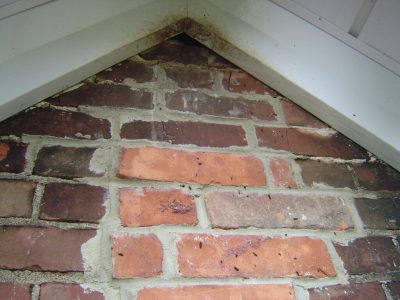
- Staining and rub marks. Bats leave a brown or greasy discoloration where they squeeze through an opening repeatedly. On light stone or stucco it is often visible from the ground.
- Sound. Scratching, rustling, or high chittering from an attic or wall cavity, usually loudest around dusk and again before dawn as the colony leaves and returns.
- Odor. A strong ammonia smell from accumulated guano and urine, which tends to become noticeable in warm weather.
- Bats circling the house at dusk. Watching your own roofline at sunset is the single most reliable way to find an entry point. If bats are emerging from your house rather than flying over it, you’ll see it in the first twenty minutes after sundown.
Why Bats in Your Attic Are a Health Concern
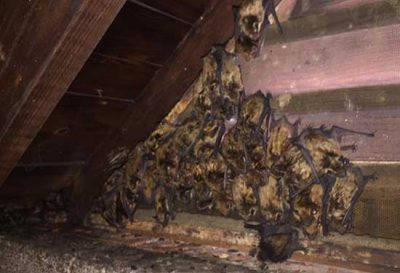
Bats are valuable animals and we remove them without harming them, but a colony inside a home is a genuine problem and not something to leave alone.
Accumulated guano is the main issue. As it builds up and dries, it can support the growth of Histoplasma capsulatum, a fungus whose spores become airborne when the material is disturbed. Inhaling those spores can cause histoplasmosis, a respiratory infection. This is why we do not simply sweep out an attic — guano removal is done with proper protective equipment and containment, and heavily soiled insulation is removed and replaced rather than cleaned.
Rabies is the concern people ask about most. The large majority of bats do not carry it, but a small percentage do, and any direct contact between a bat and a person or pet should be treated seriously and discussed with a doctor or veterinarian. Do not attempt to catch or handle a bat yourself.
There’s also straightforward structural damage. Urine and guano saturate insulation, stain ceilings and drywall, and over a long enough occupancy can rot roof sheathing and framing. A colony that’s been in place for several seasons often means insulation replacement and repair work in addition to the exclusion itself.
Bat Exclusion in Ardmore, PA — and Why Timing Matters
We do not trap and relocate bats. The method that actually works is exclusion: we inspect the structure, identify every opening a bat is using, seal all of them permanently, and fit the active entry points with one-way devices that let the colony exit and prevent it from getting back in. Once the structure is confirmed empty, the devices come off and those last openings are sealed. Then we handle the cleanup — guano removal, sanitizing, and insulation replacement where it’s needed.
Timing is the part homeowners don’t expect. In Pennsylvania, bat exclusions cannot be performed during the maternity season, roughly mid-May through August 1st. During that window the colony includes flightless pups. Sealing the adults out means the young starve inside the structure, which is inhumane, illegal, and leaves you with a far worse problem than the one you started with — dead animals in an inaccessible space and adult bats working their way into living areas trying to reach them.
If you find bats during the restricted period, it’s still worth calling. We can inspect the property, document the entry points, remove any bat that has gotten into living space, and have the exclusion scheduled and ready for the first day the work can legally begin. Hibernating bat populations across the Northeast have suffered severe losses from White Nose Syndrome, so avoiding additional harm to the species genuinely matters. Contact Seitz Wildlife Services to schedule your Ardmore bat exclusion at the right time of year.
Contact Seitz Wildlife Services
Seitz Wildlife Services is licensed, insured, and family-owned, serving Ardmore, Lower Merion Township, and communities across Montgomery, Chester, Delaware, and Berks Counties. Call (610) 999-2606 for a free phone consultation about bat removal at your Ardmore property.