
Bat Removal Services in Haverford, PA
Seitz Wildlife Services is a fully licensed, family-owned and operated company providing bat removal and wildlife control throughout Haverford and the surrounding Main Line. We handle the full range of bat situations property owners run into — bats in an attic, bats in a chimney, bats in a carriage house or detached garage, and bats flying through living space. Our services also include bat guano and dropping removal, attic clean-outs, insulation replacement, bat house installation, and bat proofing, also known as bat exclusion.
Haverford has an unusual amount of protected green space for a community this close to Philadelphia. The Haverford College campus is an arboretum in its own right, with a pond, unlit walking trails, and specimen trees that have been growing for well over a century. Add the open turf and mature plantings of the Merion Cricket Club grounds and the surrounding golf and club land, and you have a large, dark, insect-rich foraging area sitting in the middle of an otherwise built-up suburb. Bats hunt over that ground all night and roost during the day in whatever nearby structure offers a dry, undisturbed space — which in Haverford usually means a hundred-year-old roof. If you’re dealing with a bat intrusion in Haverford, contact Seitz Wildlife Services for a free phone consultation.
How Bats Get Into Haverford Homes and Outbuildings
Haverford’s building stock creates a pattern we see over and over here, and it’s different from the pattern in neighboring Havertown or Ardmore.
Detached outbuildings are usually where it starts. Haverford properties tend to be large and to include structures other than the house — carriage houses, converted stables, detached garages with unfinished space or old servants’ quarters above, pool houses, garden sheds, and greenhouses. These share one quality that makes them ideal: nobody goes in them for months at a time. They’re unheated, unlit, quiet, and rarely maintained at the roofline. A maternity colony will settle into a carriage house loft long before it settles in a house, and by the time anyone notices bats around the main residence, the outbuilding has usually been occupied for a season or more. If you have bats at your house in Haverford, we inspect every structure on the property, not just the one you called about. Excluding the house and leaving the carriage house untouched means the colony is still on site and looking for a new way in.
Large stone homes with slate roofs. The estate and near-estate homes built here between the 1880s and the 1920s have complicated rooflines — multiple gables, dormers, turrets, deep eaves — and generous attic volume that stays temperature-stable through the summer. The slate roofing lifts and slips over time, and the copper and lead flashing at chimneys, valleys, and dormer cheeks is often original. Century-old flashing seams are the most common entry point we find on these houses. A gap the width of your finger is all it takes.
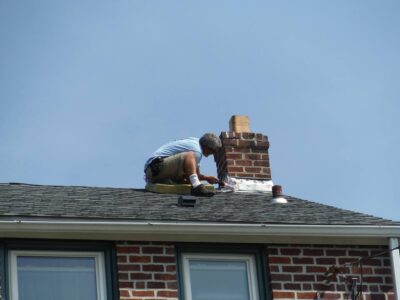
Multiple chimneys. Homes of this age and size frequently have three or four flues, some long disused. An uncapped or damaged flue is an open door, and a disused one may go unnoticed for years. Chimney caps are one of the cheapest and most effective preventive measures available on a Haverford property.
Later infill housing. The newer homes scattered through the area fail more conventionally — ridge vent terminations, gable louvers with failed screening, soffit and fascia gaps, and seams where an addition ties into the original roofline.
Signs of a Bat Infestation in Haverford, PA
Bats are quiet and nocturnal, so a colony can occupy a structure for an entire season unnoticed — particularly in a building you don’t use daily. The most common signs Haverford property owners report:
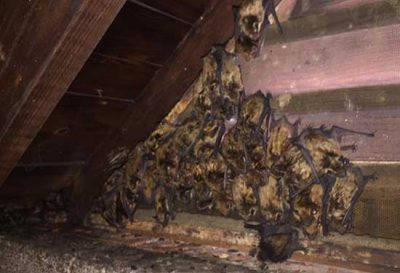
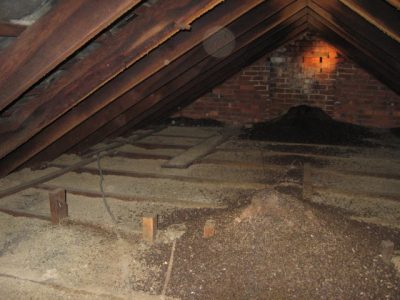
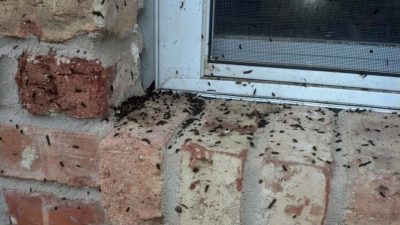
- Droppings, called guano. Small, dark, crumbly pellets in piles below entry points — along a foundation, on a windowsill, on patio furniture, on the floor of a garage or carriage house, on a car parked underneath. In an attic or loft, guano accumulates directly under the roost.
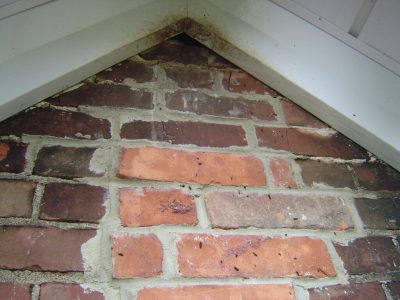
- Staining and rub marks. A brown, greasy discoloration where bats push through the same opening repeatedly. On light stone and stucco it’s often visible from the ground.
- Sound. Scratching, rustling, or high-pitched chittering from an attic or wall cavity, loudest around dusk and again before dawn.
- Odor. A strong ammonia smell from accumulated guano and urine, usually most noticeable in warm weather.
- Bats circling at sunset. Watching your rooflines for the first twenty minutes after sundown is the most reliable way to find the entry point. On a Haverford property, watch the outbuildings as well as the house.
Why Bats in Your Attic Are a Health Concern
Bats are beneficial animals and we remove them without harming them, but a colony inside a building is a genuine problem that shouldn’t be left alone.
Accumulated guano is the main issue. As it builds and dries, it can support growth of Histoplasma capsulatum, a fungus whose spores become airborne when the material is disturbed. Inhaling those spores can cause histoplasmosis, a respiratory infection. This is why we don’t simply sweep out an attic or a loft — guano removal is done with proper protective equipment and containment, and heavily soiled insulation is removed and replaced rather than cleaned. In a long-occupied carriage house loft, the accumulation can be substantial.
Rabies is the question people ask about most. The large majority of bats do not carry it, but a small percentage do, and any direct contact between a bat and a person or a pet should be treated seriously and discussed with a doctor or veterinarian. Never attempt to catch or handle a bat yourself.
There’s also straightforward structural damage. Urine and guano saturate insulation, stain plaster and ceilings, and over several seasons will rot roof sheathing and framing. On a historic Haverford property, that framing and interior plasterwork is expensive to repair, which is a strong argument for addressing a colony early rather than living with it.
Bat Exclusion in Haverford, PA — and Why Timing Matters
We don’t trap and relocate bats. The method that works is exclusion. We inspect every structure on the property, identify every opening the colony is using, seal all of them permanently, and fit the active entry points with one-way devices that let bats out and prevent them from getting back in. Once the structures are confirmed empty, the devices come off and those final openings are sealed. Then we handle cleanup — guano removal, sanitizing, and insulation replacement where it’s warranted.
Timing is the part property owners don’t anticipate. In Pennsylvania, bat exclusions cannot be performed during the maternity season, roughly mid-May through August 1st. During that window the colony includes flightless pups. Sealing the adults out means the young starve inside the structure — inhumane, illegal, and a far worse outcome than the original problem, since you’re left with dead animals in an inaccessible space and adult bats working their way into living areas trying to reach them.
If you find bats during the restricted period, it’s still worth calling. We can inspect the property, document the entry points, remove any bat that has gotten into living space, and have the exclusion scheduled for the first day the work can legally begin. Hibernating bat populations across the Northeast have suffered severe losses from White Nose Syndrome, so avoiding additional harm to the species matters. Contact Seitz Wildlife Services to schedule your Haverford bat exclusion at the right time of year.
Contact Seitz Wildlife Services
Seitz Wildlife Services is licensed, insured, and family-owned, serving Haverford, neighboring Havertown, and communities throughout Delaware, Montgomery, Chester, and Berks Counties. Call (610) 999-2606 for a free phone consultation about bat removal at your Haverford property.