
Bat Removal Services in Sinking Spring, PA
Seitz Wildlife Services is a fully licensed, family-owned and operated company providing bat removal and wildlife control throughout Sinking Spring, Spring Township, and the surrounding Berks County area. We handle the full range of bat situations property owners run into — bats in an attic, bats in a chimney, bats in a barn or outbuilding, and bats flying through living space. Our services also include bat guano and dropping removal, attic clean-outs, insulation replacement, bat house installation, and bat proofing, also known as bat exclusion.
The borough takes its name from a spring at the center of town that used to disappear during dry spells, draining away through fissures in the limestone underneath before resurfacing later. That limestone is the reason bat activity here is as steady as it is. Fissured limestone country gives bats natural shelter — rock crevices, sinks, and old quarry workings — and this stretch of Berks County has plenty of all three. Add the insect production off Cacoosing Creek and the Tulpehocken beyond it, and you have a resident bat population that doesn’t leave the area seasonally the way it does in some markets. If you’re dealing with a bat intrusion in Sinking Spring, contact Seitz Wildlife Services for a free phone consultation.
How Bats Get Into Sinking Spring Homes
Sinking Spring and the surrounding parts of Spring Township hold three fairly distinct kinds of building, and each fails differently.
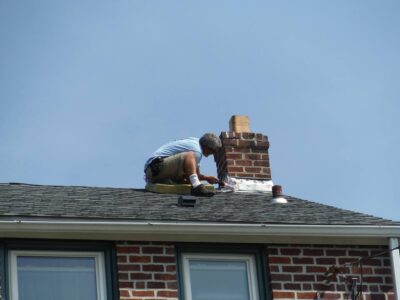
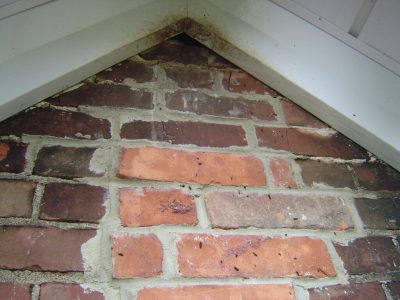
Older homes along the Penn Avenue corridor. The village housing through the center of the borough runs from the nineteenth century into the early 1900s — frame and brick, with original wood soffits, frieze boards, and cornice returns. Those wood details shrink, cup, and pull away from the sheathing as they age, and the gap that opens behind a frieze board is exactly the shape a bat is looking for. Chimney flashing and the seams around later dormer and porch additions are the other consistent problem areas on these houses.
Stone farmhouses, barns, and outbuildings. Head west and southwest of the borough and the housing thins into older farm properties. Bank barns, springhouses, equipment sheds, and detached garages are prime roosting structures — unheated, unlit, quiet for months at a time, and rarely maintained at the roofline. Barns in particular can hold very large colonies. If you have bats at the house on a property like this, the barn is usually where the colony actually lives, and excluding one without the other accomplishes very little.
Post-war and newer development. The ranches, splits, and newer subdivisions built through Spring Township fail more conventionally — ridge vent terminations that were never sealed properly, gable louvers with rusted or missing screening behind them, soffit and fascia gaps, and construction seams where an addition ties into the original roofline.
One thing worth understanding here that isn’t true everywhere: because the surrounding geology gives bats good natural winter shelter close by, a house that gets colonized and never properly sealed tends to be recolonized reliably, year after year. Excluding the animals without closing the openings is a temporary fix in Sinking Spring.
Signs of a Bat Infestation in Sinking Spring, PA
Bats are quiet and nocturnal, so a colony can occupy a building for an entire season before anyone notices — especially in a barn or outbuilding nobody goes into. The most common signs Sinking Spring property owners report:
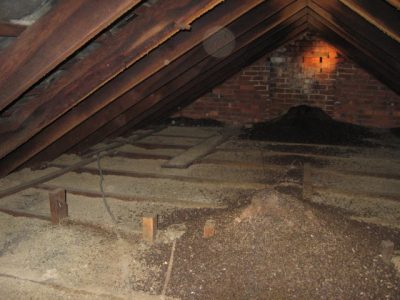
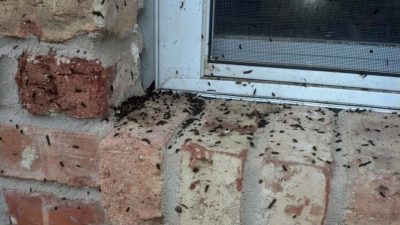
- Droppings, called guano. Small, dark, crumbly pellets in piles below entry points — along a foundation, on a windowsill, on porch furniture, on a barn floor, on equipment parked underneath. In an attic or loft, guano accumulates directly under the roost.
- Staining and rub marks. A brown, greasy discoloration where bats push through the same opening night after night. On painted wood trim and light stone it’s often visible from the ground.
- Sound. Scratching, rustling, or high-pitched chittering from an attic or wall cavity, loudest around dusk and again before dawn.
- Odor. A strong ammonia smell from accumulated guano and urine, usually most noticeable in warm weather.
- Bats circling at sunset. Watching your own rooflines for the first twenty minutes after sundown is the most reliable way to locate an entry point. On a property with outbuildings, watch those too.
Why Bats in Your Attic Are a Health Concern
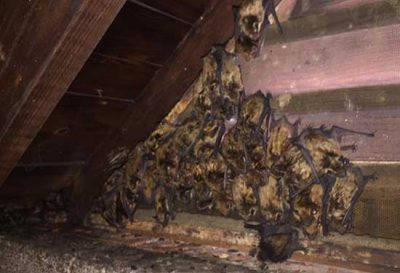
Bats are beneficial animals and we remove them without harming them, but a colony inside a building is a genuine problem that shouldn’t be left alone.
Accumulated guano is the main issue. As it builds and dries, it can support growth of Histoplasma capsulatum, a fungus whose spores become airborne when the material is disturbed. Inhaling those spores can cause histoplasmosis, a respiratory infection. That’s why we don’t simply sweep out an attic or a barn loft — guano removal is done with proper protective equipment and containment, and heavily soiled insulation is removed and replaced rather than cleaned. In a barn that has been occupied for years, the accumulation can be substantial.
Rabies is the concern people ask about most. The large majority of bats do not carry it, but a small percentage do, and any direct contact between a bat and a person, a pet, or livestock should be taken seriously and discussed with a doctor or veterinarian. Never try to catch or handle a bat yourself.
Then there’s structural damage. Urine and guano saturate insulation, stain ceilings and drywall, and over several seasons will rot roof sheathing and framing. In older frame homes and barns with original timber, that damage progresses further than people expect before it becomes visible from inside.
Bat Exclusion in Sinking Spring, PA — and Why Timing Matters
We don’t trap and relocate bats. The method that works is exclusion. We inspect the structure — and any outbuildings on the property — identify every opening the colony is using, seal all of them permanently, and fit the active entry points with one-way devices that let bats out and prevent them from getting back in. Once the structure is confirmed empty, the devices come off and those final openings are sealed. Then we handle cleanup: guano removal, sanitizing, and insulation replacement where it’s needed.
Timing is the part property owners don’t expect. In Pennsylvania, bat exclusions cannot be performed during the maternity season, roughly mid-May through August 1st. During that window the colony includes flightless pups. Sealing the adults out means the young starve inside the structure — inhumane, illegal, and a far worse outcome than the original problem, since you’re left with dead animals in an inaccessible space and adult bats forcing their way into living areas trying to reach them.
If you find bats during the restricted period, it’s still worth calling. We can inspect the property, document the entry points, remove any bat that has gotten into living space, and have the exclusion scheduled for the first day the work can legally begin. Hibernating bat populations across the Northeast have suffered severe losses from White Nose Syndrome, so avoiding additional harm to the species matters. Contact Seitz Wildlife Services to schedule your Sinking Spring bat exclusion at the right time of year.
Contact Seitz Wildlife Services
Seitz Wildlife Services is licensed, insured, and family-owned, serving Sinking Spring, Spring Township, nearby Shillington, and communities across Berks, Chester, Montgomery, and Delaware Counties. Call (610) 999-2606 for a free phone consultation about bat removal at your Sinking Spring property.